

Why RPM Programs Lose Momentum After Launch—and What to Review
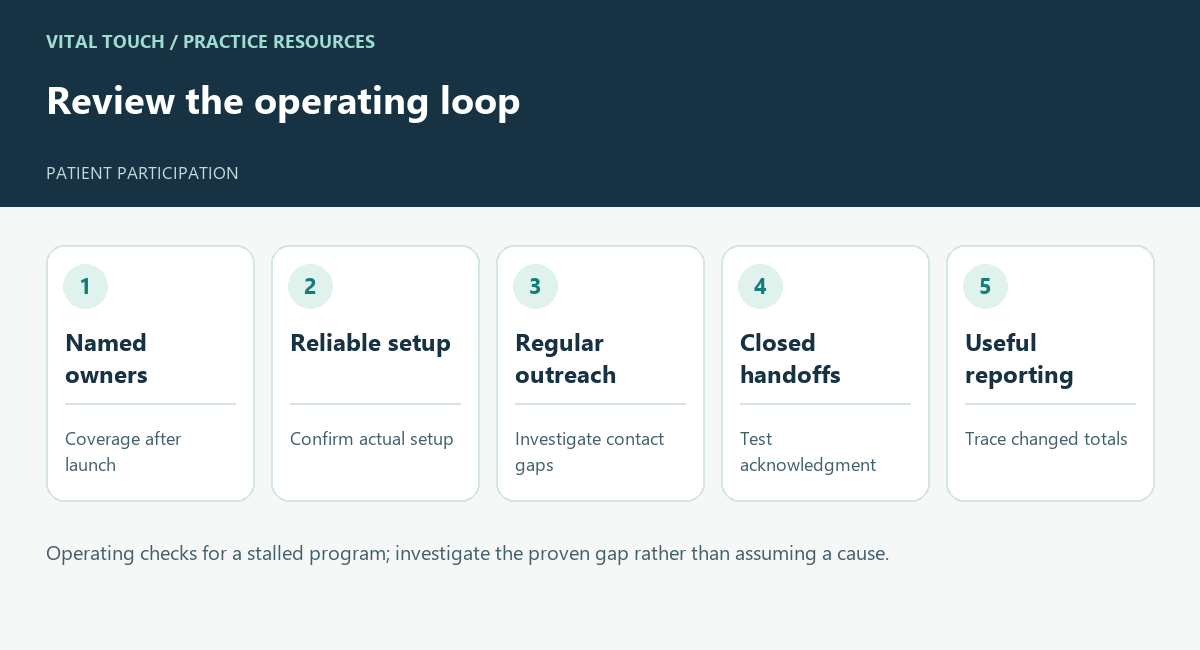
Operating checks for a stalled program; investigate the proven gap rather than assuming a cause.
When an RPM program loses momentum after launch, begin by reviewing the recurring work. Ask which tasks are being completed, which are waiting, and where ownership becomes unclear.
Do not assume a single cause from an enrollment chart. A stalled program may involve setup problems, staff coverage, unsuccessful contact, unclear handoffs, or reporting definitions that hide the actual issue. The first useful step is to locate the earliest stage that is not working as intended.
Check whether ownership survived the launch
Launch teams often have a clear project lead. Vital Touch’s documented model includes Care Managers supporting patients and Customer Success Managers supporting the practice relationship. Ongoing review covers engagement barriers, device issues, escalation follow-through, documentation, and reporting questions. That support continues after onboarding, with clinical decisions and agreed practice responses remaining with the provider team.
Review who performs each task when the primary person is absent. If recurring work depends on spare capacity, discuss whether staffing and service scope match the enrolled population. An expansion plan should not conceal an unresolved capacity gap.
Inspect setup completion
Compare enrollment with evidence of a working device and supported participation. Review unresolved setup issues before interpreting a lack of incoming information as patient disengagement.
Ask whether the support team knows which problems remain open and whether patients have received usable help. Shipment and attempted instruction do not necessarily establish that setup was successful.
Follow one open handoff
Select a fictional training case or an authorized internal case for review. Trace it from identification through communication, acknowledgment, next action, and closure.
If the chain stops, identify the missing owner or decision. A handoff process should preserve visibility until the appropriate action is recorded. Sending another reminder may be useful, but it should follow an understanding of where responsibility lies.
Review what the report leaves out
Ask whether the report distinguishes attempted outreach, successful contact, participation, and unresolved support needs. Verify that the time periods and definitions are consistent.
A summary can look stable while open work accumulates underneath it. Conversely, a reporting change can make performance appear worse without an actual operating decline. Use source-backed evidence to tell the difference.
Repair a specific failure before adding volume
Choose a bounded improvement tied to the proven gap. Examples include clarifying backup coverage, simplifying setup instructions, or repairing an acknowledgment process.
Agree on the observable result that will show the change worked. Review that result before increasing enrollment or adding a new program. This preserves attention for the operating behavior that matters.
If your practice is evaluating an external partner, ask how recurring responsibilities are maintained after onboarding. Vital Touch’s service overview describes sustained operational support; use it as a starting point for a discussion about coverage, exceptions, and visibility.
