

Patient Engagement in Remote Care: Finding the Barrier Before Adding Reminders
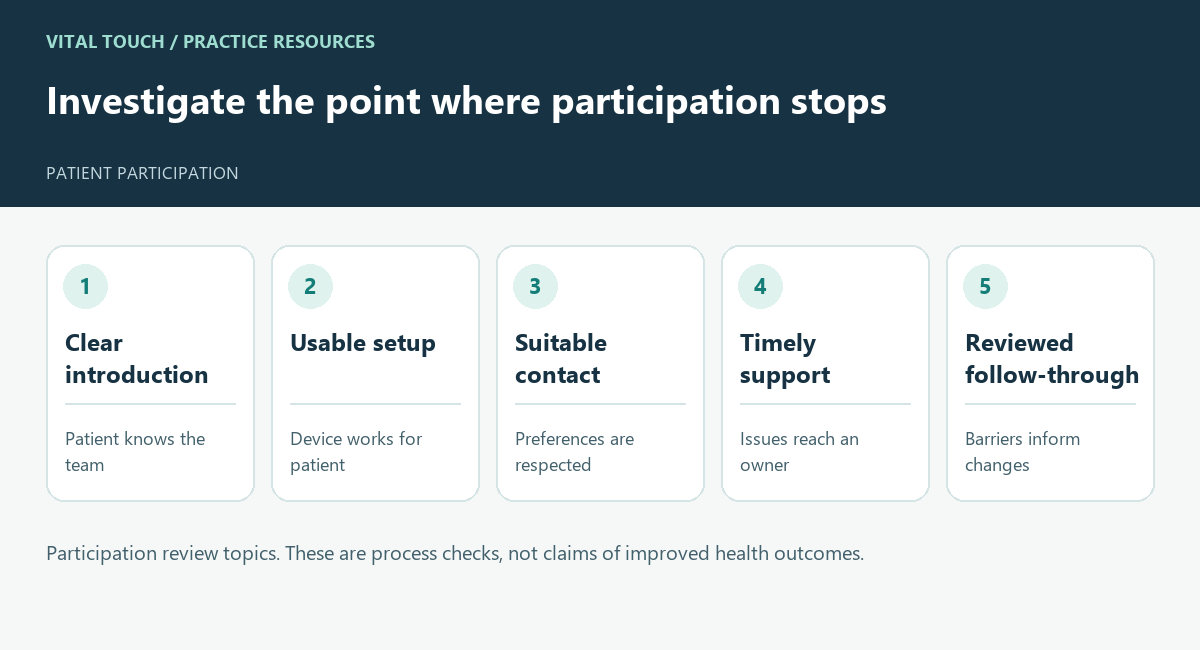
Participation review topics. These are process checks, not claims of improved health outcomes.
Patient engagement in remote care is easier to evaluate when the team can see where participation stops. A patient who has not finished device setup needs different support from someone who does not recognize the care team’s telephone number.
Before adding reminders, ask what the current workflow knows about the barrier. More messages do not necessarily resolve confusing instructions, an unsuitable contact method, or a support request that has not been answered.
Separate the participation stages
Define the stages your team wants to observe. Examples include service introduction, setup completion, successful contact, ongoing participation, and support needed.
Use labels that reflect actual evidence. An attempted call is not a completed conversation, and an enrolled patient is not automatically an active participant. The stages should help the team choose a next action rather than make a summary look better.
Ask whether the patient recognizes the team
Review how the practice introduces the program and how external staff identify themselves. Patients may need a simple way to verify a call before discussing their care.
Make the relationship clear in approved patient-facing materials. Ask the practice how callers should respond when a patient is uncertain, and avoid making participation feel like an unexpected sales conversation.
Check whether support has solved the problem
Vital Touch Care Managers support engagement through patient education, follow-up calls or messages, device troubleshooting, and help with barriers to the care plan. When a device needs replacement or return, the team follows the documented coordination workflow and explains the next step to the patient. A note that support was offered does not establish that the patient can now use the device or transmit information.
Review whether instructions were understandable, whether the selected contact route worked, and whether another authorized form of assistance is appropriate. Staff should follow approved instructions and route clinical questions to qualified personnel.
Respect contact preferences
Agree on how the team records and uses communication preferences within the practice’s policies. Keep language and accessibility needs visible to the appropriate staff.
If outreach repeatedly fails, review the reason with the responsible team. Distinguish a request to stop, incorrect contact information, technical difficulty, and an unanswered attempt rather than placing them all in one inactive category.
Review patterns without blaming patients
An operational review can ask which onboarding stage produces the most unresolved work and which support requests recur. Use those findings to improve the process.
Set measures with clear denominators and time periods. For example, setup completion among patients entering onboarding describes a different question from successful contact among patients scheduled for outreach. Neither alone proves improved clinical outcomes.
Vital Touch describes ongoing patient outreach and device support as parts of its remote-care operating model. Explore the services and ask how participation barriers would be identified and resolved for your practice.
