

Chronic Care Management Workflow: From Outreach to Follow-Through
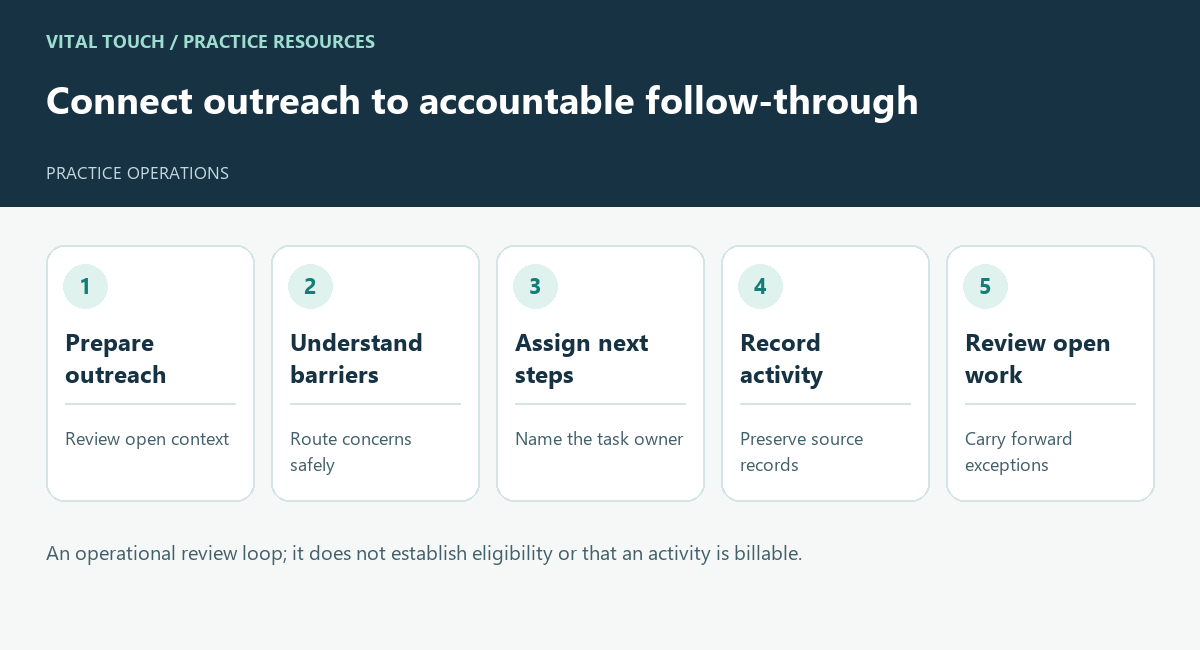
An operational review loop; it does not establish eligibility or that an activity is billable.
A chronic care management workflow should connect patient outreach to the work that follows it. A call may reveal an appointment question, a medication concern, or difficulty following a care plan. The program needs a way to route that information, record the next step, and track whether it was addressed.
CMS describes CCM as managing multiple chronic conditions and identifies a comprehensive care plan as part of the provider’s role. This article offers an operational review framework; it does not replace current eligibility, clinical, or billing requirements.
Prepare before contacting the patient
Give the team an approved way to review relevant information before outreach. Vital Touch Care Managers help maintain and reinforce the care plan under the practice’s clinical oversight. Monthly work can include medication coordination, appointment support, patient education, identifying barriers, documenting activity and time, and escalating concerns to the provider. Open issues carry forward until the appropriate follow-up is recorded.
The preparation process should respect access boundaries. Staff need the information appropriate to their role, with a secure route for questions or missing context. A copied list that becomes outdated is a poor substitute for an agreed source.
Turn the conversation into usable next steps
Structure outreach around understanding the patient’s current needs and barriers. Use approved guidance and route clinical questions to qualified personnel rather than treating the call as a script-completion exercise.
When the conversation creates a task, record what needs to happen, who owns it, and how the team will recognize completion. A general note saying “follow up” leaves the next person to reconstruct the work.
Distinguish attempts from completed contact
An unsuccessful call is different from a completed conversation. Keep that distinction visible so the team understands where participation or contact remains unresolved.
Agree on an outreach process that respects patient preferences and the practice’s policies. Review repeated unsuccessful contact for possible barriers rather than assuming the patient no longer wants support.
Document the work consistently
Ask the team to demonstrate how activity is recorded and how source records support any summary report. Establish a process for corrections and questions about incomplete information.
Billing personnel should verify current documentation and time requirements separately. An operational checklist cannot establish that a particular service is billable or that a claim will be paid.
Review exceptions at the end of the period
Focus a routine review on unresolved patient concerns, incomplete handoffs, repeated contact problems, and documentation questions. Distinguish completed tasks from items awaiting a clinician or patient response.
Use the review to decide what needs attention in the next period. It should preserve continuity rather than resetting open work when the calendar changes.
Vital Touch describes monthly outreach, care coordination, time tracking, and documentation support within its CCM service. Review the published scope and ask how those tasks connect to your practice’s existing care processes.
