

What Your Practice Still Owns When You Outsource RPM and CCM
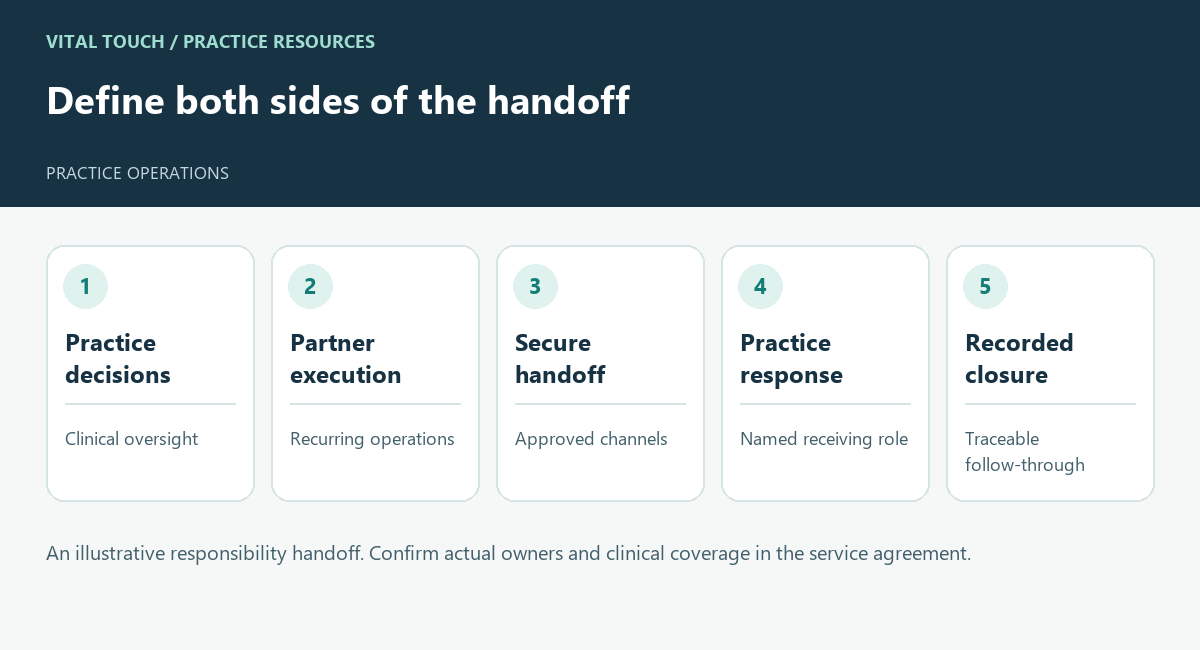
An illustrative responsibility handoff. Confirm actual owners and clinical coverage in the service agreement.
Outsourcing RPM and CCM can transfer recurring operational tasks to a partner. Your practice still needs to establish how clinical decisions, patient communication, and billing review will work.
The service agreement should make those boundaries understandable to the people using the program. A physician, front-desk colleague, billing lead, and external care coordinator should be able to describe what happens when an issue needs the practice’s attention.
Keep clinical oversight explicit
Identify the clinician responsible for program oversight and the route for questions requiring a clinical decision. Agree on how the care team receives approved instructions and how changes are communicated.
Avoid leaving responsibility attached only to a general inbox. Name a primary practice contact and a backup, and establish how the partner should proceed when either is unavailable. Response expectations should reflect the practice’s approved clinical protocols and the partner’s actual service coverage.
Establish patient communication boundaries
Patients should understand the relationship between the practice and the external team. Decide how staff introduce the service, how patients can verify a caller, and where administrative questions should go.
Review patient-facing instructions together. Those instructions should accurately explain contact availability and urgent-care boundaries. An outsourced monitoring arrangement should not be presented as continuous emergency coverage unless that exact service is genuinely provided and approved.
Retain a billing review process
Vital Touch prepares the operational documentation and code information. The biller submits claims and provides claim-status and collections reporting. Your practice retains clinical oversight, receives payer payments, and reviews the resulting reports and invoices. If you use your own biller, agree on the reporting needed for reconciliation. If your practice needs billing support, Vital Touch can refer you to Acuity Health Services. Identify the records needed to support that review and the person who resolves missing or inconsistent information.
Ask how corrections are handled after a reporting period closes. Your team should be able to trace a change to its source rather than relying on an unexplained replacement total. Current billing requirements need separate verification by the appropriate personnel.
Make unresolved work visible
Agree on a routine review of open handoffs, unsuccessful contacts, device problems, and documentation questions. Give each unresolved item an owner and a next action.
A useful review is small enough to run consistently. It should focus on exceptions requiring a decision rather than recreating the partner’s entire task list. The purpose is to preserve accountability at the boundary between teams.
Write a one-page responsibility agreement
Before launch, document which tasks the partner performs, which decisions remain with the practice, and how the teams exchange information securely. Use that agreement in onboarding and revise it when an approved service boundary changes.
Vital Touch’s published model retains practice clinical oversight and billing control while its team operates recurring remote-care workflows. Explore that division of work and compare it with your own practice requirements.
