
How to Choose a Fully Managed RPM and CCM Partner
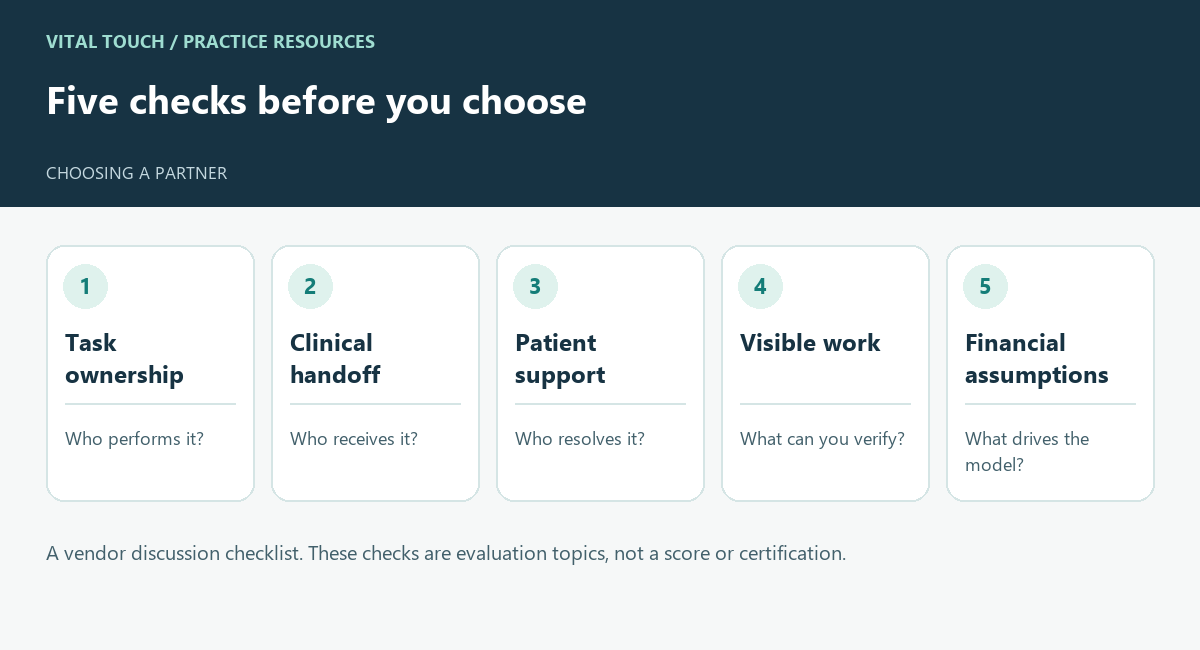
A vendor discussion checklist. These checks are evaluation topics, not a score or certification.
Choosing a remote-care partner starts with a practical question: who will do the work after the program launches?
A proposal may describe devices, software, and projected revenue. Your practice also needs to understand who will enroll patients, handle device questions, coordinate outreach, document activity, and bring issues to the clinical team.
Before selecting a partner, ask these five questions.
1. Who owns each recurring task?
Request a written responsibility map covering patient identification, onboarding, device support, monitoring, outreach, documentation, and billing support.
“Fully managed” should describe a clear division of work. Ask which responsibilities remain with your staff and what happens when a task is missed.
2. How does information reach your clinicians?
Ask the partner to walk through its escalation process. Who reviews information? How are concerns communicated? Who follows up when the practice needs to respond?
Your clinical team should understand its responsibilities before enrollment begins.
3. What happens when patients disengage?
Ask how the partner handles unsuccessful outreach, device difficulties, and interrupted participation. Request an example of how unresolved issues are tracked and reported.
A launch plan should include ongoing support, not just initial enrollment.
4. What can your practice verify?
Ask to see a sample operational report. Can your team distinguish enrollment from participation, review completed activity, and identify items needing attention?
Clear reporting helps your practice understand what work occurred and what still needs follow-through.
5. What supports the financial proposal?
Ask which assumptions drive projected revenue and costs. Separate modeled opportunities from actual practice results, and identify who will verify current payer and billing requirements.
A useful proposal explains its assumptions clearly enough for your team to evaluate them.
Evaluate the operating model
Compare partners using the same responsibility checklist. Ask for concrete workflow examples rather than relying on broad promises.
Vital Touch handles patient enrollment and consent through established workflows, device onboarding, monitoring, patient outreach, care coordination, documentation, and preparation of billing information. The practice retains clinical oversight. The biller handles claim submission and collections reporting.
Explore Vital Touch’s services to begin evaluating whether that model fits your practice.
