

How to Evaluate RPM Program Economics Beyond Projected Revenue
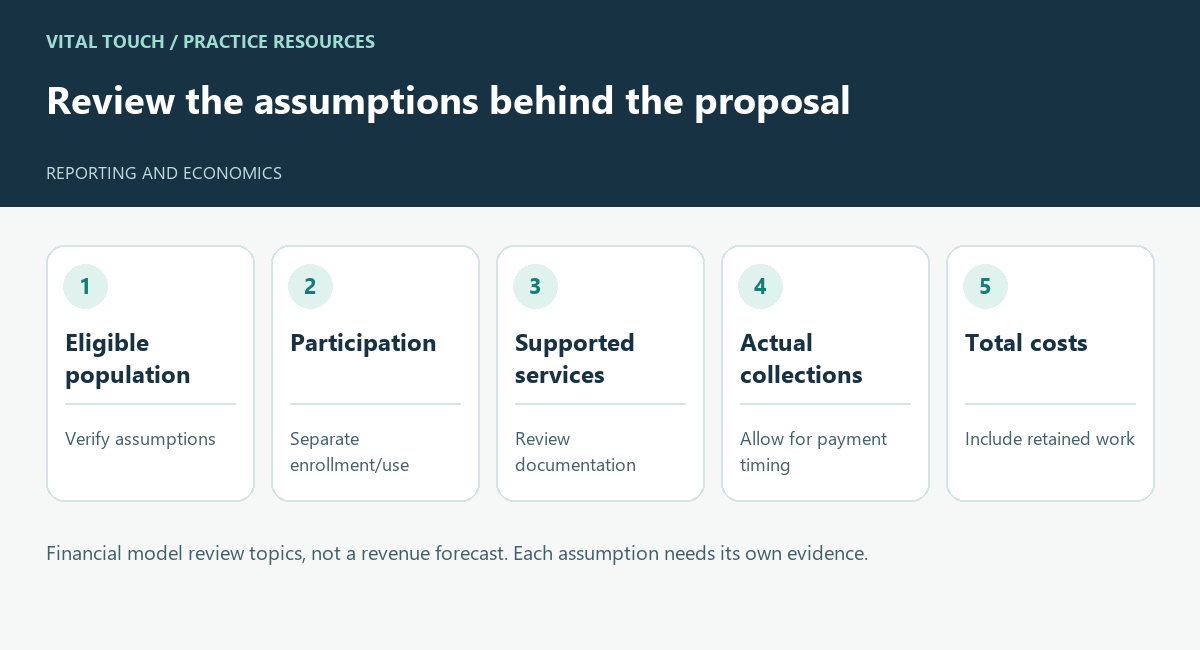
Financial model review topics, not a revenue forecast. Each assumption needs its own evidence.
Evaluating RPM program economics starts with understanding what a financial proposal actually measures. A projected reimbursement total, a submitted claim, and cash collected by the practice are different facts.
Ask the proposer to identify the assumptions connecting the patient population to each projected result. Your practice should be able to change those assumptions and understand how the financial picture changes.
Inspect the patient assumptions
Separate the population being evaluated from patients who are appropriate for enrollment, patients who agree to participate, and patients who complete relevant program activity.
Ask what evidence supports each assumption. A forecast based on an entire patient list may be useful as a preliminary scenario, but it should not be presented as confirmed recurring revenue. Your clinical and billing teams must review the relevant requirements.
Follow the path to collections
Identify whether the model estimates services, claims, allowed amounts, or collections. Then ask how timing, payer mix, claim issues, and patient financial responsibility are handled.
Request a version showing cash timing separately from the service period. A practice needs to understand when costs are incurred and when payments may arrive. Unknown values should remain visible until there is evidence to resolve them.
Include the costs your practice retains
Review partner fees, device arrangements, software charges, onboarding work, ongoing staff responsibilities, and administrative oversight. Clarify which costs are included, variable, or excluded.
Vital Touch prepares operational documentation and code information for the biller. The biller submits claims and reports claim outcomes and collections, supporting reconciliation and invoicing. Ask how your proposal connects services performed to actual collections and which costs and responsibilities remain with the practice. If your practice needs a billing referral, Vital Touch can refer you to Acuity Health Services.
Compare scenarios with consistent definitions
Ask for lower-participation, expected, and higher-participation scenarios using clearly labeled assumptions. Those scenarios are planning tools, not promised results.
Include a case in which launch takes longer or collections arrive later than expected. This helps your team understand the effect on staffing and cash without pretending that a single optimistic forecast establishes the program’s value.
Keep clinical value separate from financial evidence
A financial model does not prove improved clinical outcomes. If a proposal makes an outcome claim, request the supporting evidence and confirm whether it describes the offered program or a different setting.
Likewise, a successful operating workflow does not establish that every completed task qualifies for reimbursement. Current requirements and individual circumstances need review by the appropriate professionals.
Bring the assumption worksheet to your vendor discussion. Vital Touch’s published service scope includes operational and billing support while the practice retains billing control. Review that scope and request a proposal that makes costs, retained work, and financial assumptions explicit.
