

RPM Alert Escalation: Questions to Resolve Before Launch
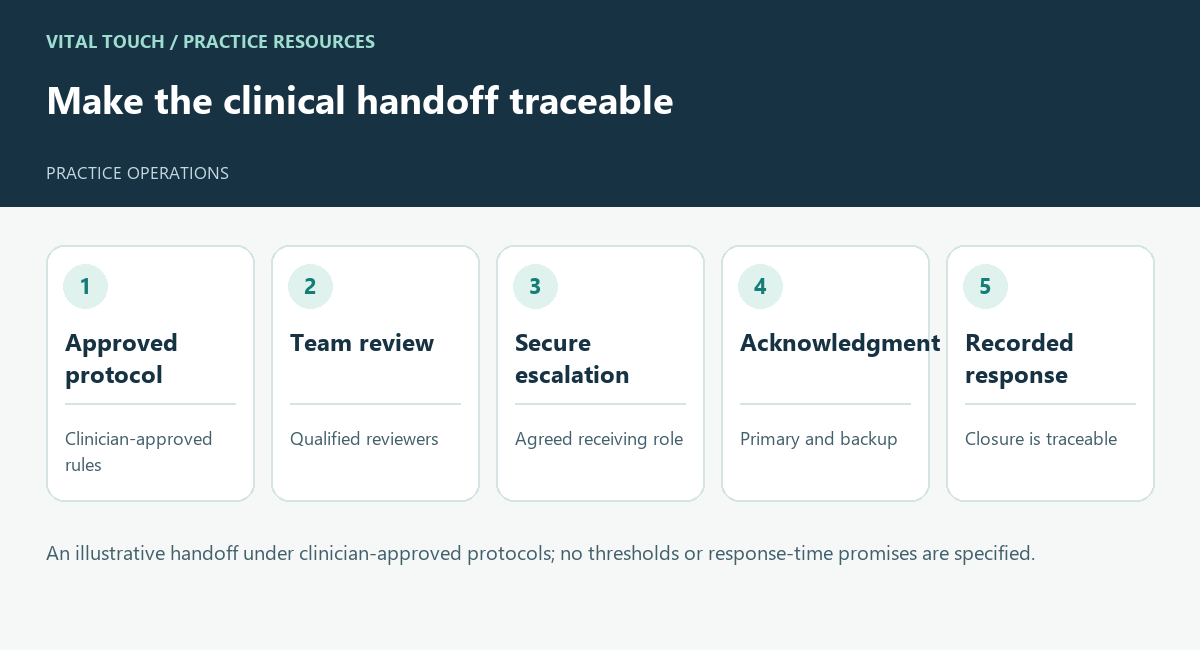
An illustrative handoff under clinician-approved protocols; no thresholds or response-time promises are specified.
An RPM alert escalation workflow needs a clear route from information review to clinical responsibility. Before launch, your practice and operating partner should agree on who reviews information, what triggers a handoff under approved protocols, and how the team records the response.
This is an operational planning framework. Clinical thresholds, urgency categories, and treatment instructions must come from the appropriate clinical authority rather than a generic article or vendor demonstration.
Start with the approved protocol
Ask your clinical lead to identify the instructions that govern review and escalation. Confirm where the current version is maintained and how updates reach the team using it.
The team should know when to route a question for clinician review and when a situation falls outside its role. Document which personnel are qualified and authorized to perform each part of the process.
Identify the receiving clinician and backup
A message sent to the practice is not the same as an acknowledged clinical handoff. Specify the receiving role, communication channel, and backup arrangements.
Discuss what happens during absences, outside agreed service hours, or when a response has not been received. Those expectations must match actual staffing and approved coverage. Do not imply emergency availability from a general claim that a program provides monitoring.
Agree on the information needed for a handoff
Ask the teams to define a concise, secure escalation record containing the context appropriate to the receiving clinician. Avoid scattering information across unapproved email, chat, or public forms.
The record should allow the practice to understand why the issue was routed and what response is being requested. Use fictional information when rehearsing the process so testing does not expose patient data.
Define acknowledgment and closure
Decide how the operating team learns that the practice received the handoff. Then distinguish acknowledgment from completion of the next action.
Vital Touch’s care team reviews patient information, documents concerns, and escalates to the provider through the agreed workflow. The practice’s approved protocol governs clinical escalation and response. Confirm the contact route, backup, service hours, and follow-through arrangements during onboarding. An item should not disappear from an exception list simply because a message was sent.
Rehearse a missed response
Test a fictional situation in which the primary contact is unavailable. Ask each team to explain its next step using the agreed workflow.
Review where the rehearsal stalls. A missing backup, unclear message destination, or inconsistent closure rule can be repaired before the workflow is used with patients.
Vital Touch’s services describe monitoring and escalation while clinicians retain clinical oversight. Review that model, then request a walkthrough of the specific handoff your practice would use.
